It's fairly unnecessary for me to chime in about my reactions to the finale, after nine seasons, of How I Met Your Mother. All of the actual professional review sites have shared their thoughts and feelings, ranging from disappointed to defensive, and this gently-read blog that I've largely ignored for the past few years isn't going to add to the conversation in any significant way. But something about the last two-part episode has inspired me to record what the show has meant to me, and how the finale made me think about my own life.
[SPOILERS AHEAD]
If by now you've seen "Last Forever," and read the largely negative reviews, then you know that it's the "twist" ending that really upset a lot of the show's fans. Of course, there are problems with the show's denouement and how it was presented. But I suspect it's only going to make more and more sense as time goes by and I continue to think about how it ended. In the pilot episode, I fell in love with Ted's falling in love with Robin on their first date, and it was a cute, funny, and startling moment when his future-narration reveals that this meet-cute brought him together with his kids' "Aunt Robin."
For nine seasons we've seen Ted and Robin's relationship grow into a complicated romance-turned-friendship. Numerous times, it's been exhausting to see them split up and get back together, when we've known since the beginning that they would not end up together. Once we finally discovered whom Ted was meant to be with, "The Mother," Tracy McConnell (pitch-perfectly played by Tony nominee Cristin Milioti), the show did an admirable job of getting us to fall in love with her throughout an awkward 'bottle episode' of a final season. She was perfect for him, intelligently designed to match him in every way, and it was a delight to see their pairing, finally.
What I didn't know until after the series ended was that her death after only a ten-year union with Ted was planned from the beginning. It's a great relief for me to know that this was the creators' intention, because it allows me to better appreciate the ways, throughout the years, that they've built towards it. When I first heard murmurs a few weeks ago that this outcome was being theorized by fans, I was initially dismayed. It did seem like a betrayal, as if the show had gone off the rails in its latter seasons, and this was one final transgression against a show which had once been so excellently-crafted and emotionally affecting.
That it was the plan all along for the show's framework of Ted telling his kids how he met their mother, to be focused primarily on his relationships with Robin, Barney, Lily, and Marshall before Tracy came into their life, makes much more sense when it's revealed that he's curious how they'd feel if he started dating Robin, six years after having lost his wife to an unspecified illness. It's understandable to be skeptical that his kids wouldn't react in such a cavalier way throughout the story if their mother is dead, but I disagree. They're teenagers, listening to their nerdy dad tell one anecdote after another that has nothing to do with their mom. And, she died when they were young children, so it's not as if he's trying to start dating immediately after the funeral. I like to think that Ted frequently regales his children with countless stories about their mother: who she was, what she was like, and what he loved about her. So this story we've been privy to doesn't seem as relevant to them as all that.
Of course, there are numerous things wrong with how the show wrapped up. I was never a fan of the final season dragging out over the course of one wedding weekend, and wish that they'd stretched the finale's years-long story arcs out through the entire ninth season instead. This would have given the writers many opportunities to creatively tease out the eventual reunion of Ted and Robin, rewarded longtime viewers with more delightful scenes in the life shared by Ted and Tracy, and more intelligently served the storylines of Lily, Marshall, and Barney.
Barney is easily the least satisfying of all the characters, both throughout the show's run, and during its marathon last episode. I was never on board for his romance with Robin, apparently life-changing, as the writers tried so hard to convince us. (It reminded me of the bad taste Grey's Anatomy gave me when uniting George and Izzie in that show's watershed third season.) Perhaps because I was so uninterested in their union, I had no problem with their divorce, but it was frustrating for the show to have burned so many calories trying to convince us that they would truly go through so many enormous changes in order to come together, and then when they come apart, for Barney to basically bounce right back. Robin truly reevaluates her life after her divorce, but Barney seems like the same old cad.
Barney was a latchkey kid with seriously complicated relationships with his mother and absentee father. This turned him into a hypersensitive young man, rawer even than Ted, who was moved to change his entire life after an early heartbreak and the tutelage of a hardened womanizer turned him into the Barney we would eventually meet. For him to try so hard to do things right, finally, and see it fail, I can't believe it wouldn't send him into a truly dark tailspin. I would have liked to see a middle-aged Barney find himself at the bottom of a whiskey bottle, struggling to find a new identity for himself. A full season of flashbacks/flashforwards would have given the character a chance to build himself back in more than just the one moment (beautifully acted by Neil Patrick Harris) when he first meets his daughter.
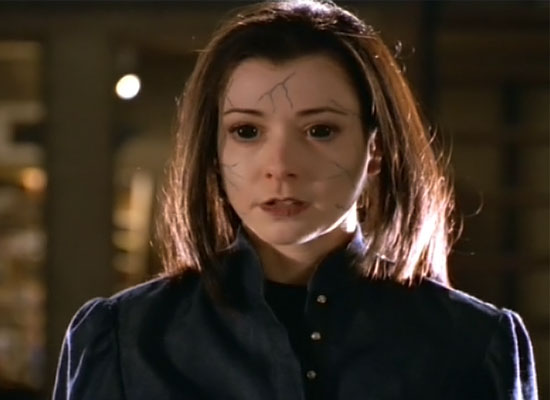
What I liked the most about the last hour was Robin's disconnection from her former friends. Some of it was inconsistent with earlier seasons' flashforwards, but it felt the most natural to me of any of the finale's "disappointments." The speech she gives to Lily when bailing on a frustrating Halloween party makes perfect sense. Why would she stick around with a well-meaning old married couple, her promiscuous ex-husband, the ex-boyfriend she suspects is the man she should have ended up with, and his beloved wife? She's successful and famous, she can avoid the pain associated with this particular group of friends and move on with her life. Of course it's sad. Life is frequently, relentlessly, sad. Alyson Hannigan's acting was excellent in this episode, possibly because she wasn't acting much at all. In a ridiculous pregnant whale costume, against a bare set, Hannigan's big watery eyes were powerful enough to make me forget she was ever Buffy's bestie (or her Big Bad).
And that's what was so great about all of the changes in the show's conclusion. Life is rarely neat and clean. People are almost never in the right place at the right time. How many times did Ted and Tracy just miss meeting each other, and how many more years could they have had together? People do marry the wrong person. People marry the right person, and lose them tragically. People marry the right person, and struggle with their relationship regardless. People have to put their dreams on hold because a baby is coming. People pursue careers that make them very happy, but still feel something is missing. Hearts get broken, more often than not.
I see now how all along the show was laying the foundation for us to be okay with Ted and Robin coming together in their fifties, only ready to be together after being dragged through the highs and lows of life first. That girl in the fifth season episode "The Window," whose numerous relationships all had to start and end before she could be reunited with her childhood sweetheart. Stella, who eventually found her way back to her daughter's father after jilting Ted at the altar. One of my favorite characters, the almost-Mother Victoria, who came into Ted's life before he was ready to let her go for a time, and whose own wedding was prevented at the last minute. There's even the first season episode "Return of the Shirt," where Ted seeks love by getting back together with a former flame, only to realize he hasn't changed enough since their first breakup. Finally, take Tracy's deceased boyfriend Max, whose death she had to overcome before she'd be ready to turn down Louis' proposal, even though he is a great guy, before she can be ready to meet Ted.
Relationships end, and they change, and sometimes we find our way back to the people we used to love, or didn't love enough, but a lot of the time we don't. When How I Met Your Mother premiered I was just eighteen, a sophomore in college, and the characters seemed majorly grown-up (Major Lee Grownup). Now, I am pretty much the same age they were when it all started. I have friends who are lawyers, I have friends who are married, and I've quit jobs. I've fallen in love. I've had my heart broken. And I've seen many of my friendships change.
It was this that made me cry when watching the finale, seeing the rift between Lily and Robin and knowing how this has been mirrored in my own life. Today I discussed the show with someone I became very close to in college, and thought about how HIMYM ending was one of the "big moments" we'd be sure to discuss. Coincidentally, this conversation happened on the day she taught her first college class as a professor. I asked if she, like Ted, walked into the wrong classroom at first. Over the years, there have been drunken nights, inside jokes, hook-ups, road trips, and first kisses in my life to rival those portrayed on the show. Once I managed to tune into the most poorly-timed rerun of the episode when Victoria moves to Germany, while visiting my boyfriend who lived in another country. Our relationship didn't last either.
I so wish that the finale had just been tighter, and more consistent with some of the show's set-ups. I wish the Slap Bet had been more entertainingly resolved, and that we knew what happened in the Pineapple Incident. I wish we'd gotten to spend more time with The Mother, as surely Ted and their children did too. I wish the final season had been rewritten, and that later seasons had been better paced overall. (I wish a lot of things in my real life had gone differently, too.) But I wish all of this because in the Golden Age of television that has come about in my twenties, almost no show has better spoken to what it's like to be me. Mad Men's Peggy has resonated with me, there's the titular Veronica Mars, and elements of shows like Happy Endings have struck a chord. But I think when the time comes for me to go back to the beginning and watch all over, I'll be so glad that Ted, Marshall, Lily, Robin, Barney, and even Tracy and all the others, were in my life ... at the right time.
Tuesday, April 1, 2014


Monday, July 2, 2012
Call me crazy
 |
| Click for full size. |
- Blake Lively in Dia de los Muertos makeup - you'd only know it was her if you'd seen other advertising for the movie.
- Aaron Taylor-Johnson looking grown up and scruffy and intense.
- Taylor Kitsch, willing you with the power of his stare to forget basically his entire film career but especially his last two movies.
- Salma Hayek almost completely obscured in shadow.
- John Travolta
- Benicio del Toro's face half-covered by what looks like a motorcycle face mask with a skull print.

In this one-sheet, you can see all of the starring actors well except for, I presume, Aaron Taylor-Johnson, whose baby blues are peering from behind a calavera-patterned helmet. The existence of this poster makes me feel that I could have been making something out of nothing when I look at the other one, but I feel like there are many contractual and social reasons behind imagery and billing in film advertisement. Taylor-Johnson is probably the least famous of all the faces on the poster, but the trailer leads me to believe that he has a bigger role than Lively - these things all come into play when the actors deals are made.
So what do you think? Am I making this up?
Thursday, June 7, 2012
Friday, September 23, 2011
I'm good at blog.
I'm sure the only thing better than my infrequent blogging would be a completely unorganized account of new television shows, halfway through the premiere block, and while I'm not fully caught up! But whatever. I don't have TV anymore (resolving this soon) so I've only been able to catch whatever's on Hulu, or whatever I see at my parents' house on the weekends. Deal with it! If a show doesn't appear on the list below, either I don't care enough to bother with it (Pan Am, Charlie's Angels, The Playboy Club), it's finished its summer run (The Secret Life of the American Teenager, Switched at Birth, True Blood), or it won't be back (or premiering) for a few months or longer (30 Rock, Apartment 23, Mad Men).
SUNDAY
The Amazing Race (8pm on CBS, premieres 9/25)
Year after year, I remain super pumped about this show. It is always fun to watch with my family, and it's such an amazingly produced reality competition. Hoping to audition for it eventually!
Once Upon a Time (8pm on ABC, premieres 10/23)
I saw the pilot for this a few months ago, and it was a little weird, but seemed promising if you're into darker network dramas. I'll probably watch a couple of episodes but it's not really my style.
Boardwalk Empire (9pm on HBO, premieres 9/25)
The first season took ages to finally get exciting, but it ended up being wonderful. It's not my favorite "high art" show but I'm excited to watch it during the desert between Breaking Bad and Mad Men.
Dexter (9pm on Showtime, premieres 10/2)
This show goes up and down in quality, but it's still mega awesome and better than a lot of other stuff I watch. I think Colin Hanks will actually be a really creepy baddie so I'm looking forward to this season.
The Walking Dead (9pm on AMC, premieres 10/16)
I thought the first season was super boring, but it's a high production value show about zombies, so.
Breaking Bad (10pm on AMC)
There are only three episodes left in what has been an incredible season of what is currently the best show on TV. How Vince Gilligan and the actors manage to manipulate the audience so thoroughly is just incredible. I am obsessed with this show and will post more in-depth thoughts when the season's done.
MONDAY
How I Met Your Mother (8pm on CBS)
One of the most affecting shows about twenty-somethings dating and dealing with relationships and growing up is reaching its breaking point. I'm hoping that this is the second-to-last season and that we can start letting it wind down. This week's reveal of Victoria was exciting because I really liked her with Ted, but I know she won't be the 'mom.' Also, I am personally more interested in Marshall and Lily's journey at this point than Barney or Robin's, and I hope they work on leveling that out.
2 Broke Girls (8:30pm on CBS)
The pilot had funnier jokes than I expected, so I will give this one at least a few more episodes to really win me over. I didn't find Kat Dennings to be particularly funny, though her character is meant to be pretty dry...it just felt like she had taken a crash course in comedic timing and was acting a bit too robotically.
TUESDAY
Glee (8pm on Fox)
Fox is annoyingly making us wait eight days before watching its content on hulu, so I haven't watched the season premiere yet. Luckily, I remember how awful the show became last season, so I'm happy to wait.
New Girl (9pm on Fox)
It's been a little while since I watched this pilot, which I found to be instantly grating. However I love Deputy Leo from Veronica Mars, and I'd be betraying my fellow twee hipsters if I didn't love Death Cab for Cutie's first lady, so you know I'll keep watching.
Raising Hope (9:30pm on Fox)
I'm also waiting until next week for this to go up on hulu, but I was charmed by this show's first season and look forward to having it back.
Sons of Anarchy (10pm on FX)
Ugh I haven't seen any of this season's first three episodes! I freaking love this show but they don't stream or put the episodes on demand so I'm at a standstill for now.
Awkward (11pm on MTV)
One of my favorite new shows. I was initially drawn to it because creator and showrunner Lauren Iungerich is an alumna of my college, but it's really wonderful. It's a bit of a hybrid between My So-Called Life, Daria, and Juno, so I don't see why it wouldn't be awesome. Also, the lady who plays the protagonist's mom used to date JC Chasez. #funfact
WEDNESDAY
Up All Night (8pm on NBC)
I didn't find the pilot to be that great, but the second episode was a bit funnier. I think the actors have good chemistry, I'm just not convinced that the premise has anything to offer. I'm sure you could say the same thing about NBC's Thursday night comedy block though, so prove me wrong, show!
Free Agents (8:30pm on NBC)
This show is going to get canceled really soon. Let's face it. It's funny and charming though, and I love seeing Kathryn Hahn given some breathing room. She's got a bit of the Judy Greer thing going - always the friend, never the star - and that's got to change soon.
Modern Family (9pm on ABC)
Everyone loves this show and so do I, but I thought the Wyoming-set season premiere was chock full of offensive sexist and homophobic "jokes." The show has tilted at this in the past but really let loose in the premiere. Let's hope it's not a trend. I am not as mad about new Lily as others are, but I do miss those babies!
Happy Endings (9:30pm on ABC, premieres 9/28)
This show rules and I'm worried that mistreatment by the network will result in a premature cancellation. I can't wait for it to come back!
THURSDAY
Community (8pm on NBC)
I am going to watch this tonight! I'm not the biggest fangirl of this show, but it is always clever and very funny, so I'm glad it's back, especially since we'll have to wait a while on 30 Rock.
Parks and Recreation (8:30pm on NBC)
The best show on NBC is back! So far I feel like they'll allow us to miss the Ben and Leslie relationship without hating the change too much. I hope so, because I love Adam Scott and his character.
Whitney (9:30pm on NBC)
I haven't seen this one yet but it looks so awful. Absolutely nothing about it appeals to me.
The Office (9pm on NBC)
Last night's season premiere was so bad that during the cold open, I thought they were joking. I've long felt that this show is a husk of its former self, so hard not to feel when one remembers how wonderful its brief predecessor was. That said, I think there's been a steep drop-off in quality this season, not entirely thanks to Steve Carell's departure. I just don't think the writers know what they're supposed to be doing at this point.
Grey's Anatomy (9pm on ABC)
My unhealthy relationship with this show continues. I'll be catching up on this one tonight, but I mean, it'll be the same soap it's been. No big deal.
Jersey Shore (10pm on MTV)
I'll never stop watching; this show rules.
It's Always Sunny in Philadelphia (10pm on FX)
I'm a week behind but thought the season premiere was a little weak. I think they could have played more with physical comedy, but whatever, it's still one of the most shockingly funny things out there, so I'm happy it's back.
SUNDAY
The Amazing Race (8pm on CBS, premieres 9/25)
Year after year, I remain super pumped about this show. It is always fun to watch with my family, and it's such an amazingly produced reality competition. Hoping to audition for it eventually!
Once Upon a Time (8pm on ABC, premieres 10/23)
I saw the pilot for this a few months ago, and it was a little weird, but seemed promising if you're into darker network dramas. I'll probably watch a couple of episodes but it's not really my style.
Boardwalk Empire (9pm on HBO, premieres 9/25)
The first season took ages to finally get exciting, but it ended up being wonderful. It's not my favorite "high art" show but I'm excited to watch it during the desert between Breaking Bad and Mad Men.
Dexter (9pm on Showtime, premieres 10/2)
This show goes up and down in quality, but it's still mega awesome and better than a lot of other stuff I watch. I think Colin Hanks will actually be a really creepy baddie so I'm looking forward to this season.
The Walking Dead (9pm on AMC, premieres 10/16)
I thought the first season was super boring, but it's a high production value show about zombies, so.
Breaking Bad (10pm on AMC)
There are only three episodes left in what has been an incredible season of what is currently the best show on TV. How Vince Gilligan and the actors manage to manipulate the audience so thoroughly is just incredible. I am obsessed with this show and will post more in-depth thoughts when the season's done.
MONDAY
How I Met Your Mother (8pm on CBS)
One of the most affecting shows about twenty-somethings dating and dealing with relationships and growing up is reaching its breaking point. I'm hoping that this is the second-to-last season and that we can start letting it wind down. This week's reveal of Victoria was exciting because I really liked her with Ted, but I know she won't be the 'mom.' Also, I am personally more interested in Marshall and Lily's journey at this point than Barney or Robin's, and I hope they work on leveling that out.
2 Broke Girls (8:30pm on CBS)
The pilot had funnier jokes than I expected, so I will give this one at least a few more episodes to really win me over. I didn't find Kat Dennings to be particularly funny, though her character is meant to be pretty dry...it just felt like she had taken a crash course in comedic timing and was acting a bit too robotically.
TUESDAY
Glee (8pm on Fox)
Fox is annoyingly making us wait eight days before watching its content on hulu, so I haven't watched the season premiere yet. Luckily, I remember how awful the show became last season, so I'm happy to wait.
New Girl (9pm on Fox)
It's been a little while since I watched this pilot, which I found to be instantly grating. However I love Deputy Leo from Veronica Mars, and I'd be betraying my fellow twee hipsters if I didn't love Death Cab for Cutie's first lady, so you know I'll keep watching.
Raising Hope (9:30pm on Fox)
I'm also waiting until next week for this to go up on hulu, but I was charmed by this show's first season and look forward to having it back.
Sons of Anarchy (10pm on FX)
Ugh I haven't seen any of this season's first three episodes! I freaking love this show but they don't stream or put the episodes on demand so I'm at a standstill for now.
Awkward (11pm on MTV)
One of my favorite new shows. I was initially drawn to it because creator and showrunner Lauren Iungerich is an alumna of my college, but it's really wonderful. It's a bit of a hybrid between My So-Called Life, Daria, and Juno, so I don't see why it wouldn't be awesome. Also, the lady who plays the protagonist's mom used to date JC Chasez. #funfact
WEDNESDAY
Up All Night (8pm on NBC)
I didn't find the pilot to be that great, but the second episode was a bit funnier. I think the actors have good chemistry, I'm just not convinced that the premise has anything to offer. I'm sure you could say the same thing about NBC's Thursday night comedy block though, so prove me wrong, show!
Free Agents (8:30pm on NBC)
This show is going to get canceled really soon. Let's face it. It's funny and charming though, and I love seeing Kathryn Hahn given some breathing room. She's got a bit of the Judy Greer thing going - always the friend, never the star - and that's got to change soon.
Modern Family (9pm on ABC)
Everyone loves this show and so do I, but I thought the Wyoming-set season premiere was chock full of offensive sexist and homophobic "jokes." The show has tilted at this in the past but really let loose in the premiere. Let's hope it's not a trend. I am not as mad about new Lily as others are, but I do miss those babies!
Happy Endings (9:30pm on ABC, premieres 9/28)
This show rules and I'm worried that mistreatment by the network will result in a premature cancellation. I can't wait for it to come back!
THURSDAY
Community (8pm on NBC)
I am going to watch this tonight! I'm not the biggest fangirl of this show, but it is always clever and very funny, so I'm glad it's back, especially since we'll have to wait a while on 30 Rock.
Parks and Recreation (8:30pm on NBC)
The best show on NBC is back! So far I feel like they'll allow us to miss the Ben and Leslie relationship without hating the change too much. I hope so, because I love Adam Scott and his character.
Whitney (9:30pm on NBC)
I haven't seen this one yet but it looks so awful. Absolutely nothing about it appeals to me.
The Office (9pm on NBC)
Last night's season premiere was so bad that during the cold open, I thought they were joking. I've long felt that this show is a husk of its former self, so hard not to feel when one remembers how wonderful its brief predecessor was. That said, I think there's been a steep drop-off in quality this season, not entirely thanks to Steve Carell's departure. I just don't think the writers know what they're supposed to be doing at this point.
Grey's Anatomy (9pm on ABC)
My unhealthy relationship with this show continues. I'll be catching up on this one tonight, but I mean, it'll be the same soap it's been. No big deal.
Jersey Shore (10pm on MTV)
I'll never stop watching; this show rules.
It's Always Sunny in Philadelphia (10pm on FX)
I'm a week behind but thought the season premiere was a little weak. I think they could have played more with physical comedy, but whatever, it's still one of the most shockingly funny things out there, so I'm happy it's back.
Tuesday, September 20, 2011
Sweet 25...
It's Back to School week over at A Bright Wall in a Dark Room! Click over there to read my essay about Never Been Kissed...
School Week: Never Been Kissed (1999)
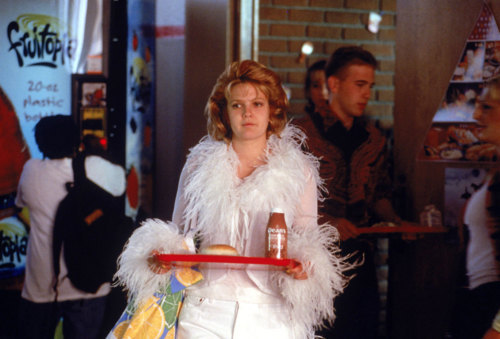
IF YOU FAIL GYM, YOU’LL NEVER GET INTO COLLEGE
by Katherine SpadaTouchdown!
I don't like to go too in-depth when reviewing movies released by my own studio, but I do want to just share a couple of thoughts on Moneyball which I saw last night. We all know I love inspirational sports movies about sports that I don't like, and Moneyball isn't really an inspirational sports movie, but damn if it isn't about baseball. Here's how little I know about baseball. Freshman year of college I bought a cute green shirt at a thrift store that said "Athletics" and had a baseball on it. I was rather emo at the time and had a penchant for ironic t-shirts from the boys' section of the Goodwill. When people kept asking me if I was from Oakland, I couldn't understand why (I thought it was just like an elementary school's P.E. department shirt). While Moneyball is largely about how statistics factor in to major league baseball, which I didn't quite follow, I still really enjoyed watching the movie. Brad Pitt was excellent in it, the writing was very impressive, and I can't wait to see more and more of Chris Pratt. I'll admit that a movie about baseball being over two hours long doesn't help you forget that baseball is super boring, but even what seemed like superfluous scenes were great.
Now onto something superficial: Philip Seymour Hoffman is four years younger than Brad Pitt but looks about twenty years older. I continue to love him more than Pitt, but man were their scenes together jarring.
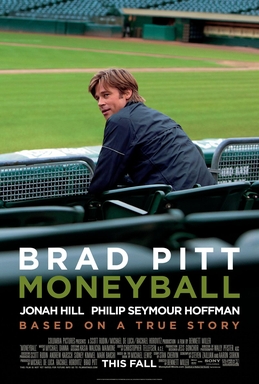
Now onto something superficial: Philip Seymour Hoffman is four years younger than Brad Pitt but looks about twenty years older. I continue to love him more than Pitt, but man were their scenes together jarring.
Come learn from my vast wisdom!
Attention Los Angeles area readers: Tonight I will be speaking at an event in West L.A. called "Moving On Up! The Young Alum Panel on Getting Hired in Hollywood." This is a 21+ event hosted by the Claremont Entertainment Mafia, an alumni resource for graduates of the Claremont Colleges working in the entertainment industry. Claremont students who are 18+ are welcome, just let the CEM members at the door know you're a student.
So Claremont alumni, and interested friends, join me tonight at 7pm at The Joint for this panel and some mingling.
The Joint
8771 W. Pico Blvd. at Robertson
Event description:
A successful career in Hollywood is exciting and lucrative, but how exactly does one begin?
Claremont Entertainment Mafia has assembled a panel of three of our most promising young alums - future movers and shakers - to discuss their own experiences on getting hired and getting promoted in the industry.
Join us for an evening where we will share anecdotes, advice, and take your questions regarding all aspects of the Hollywood ...hiring and promotion process, as well as the day-to-day grind.
DEVIN RAPSON (PO '09) got his first taste of the industry as a PA on Scooby Doo 4, in addition to interning with Oscar-winning Pomona alum Jim Taylor. He ran the feature department as coordinator at Landscape Entertainment with Bob Cooper, and recently has been hired to the prestigious Paradigm Talent Agency.
KATHERINE SPADA (CMC '08) began her career as assistant to Universal EVP Peter Cramer. After traveling the world, she currently works at Columbia as assistant to EVP of production Elizabeth Cantillon, working on such projects as The Girl with the Dragon Tattoo and the next film in the James Bond franchise.
JAVAN TAHERKHANI (CMC '08) moved up the cutthroat CAA ladder, from mailroom to floater to assistant, where he worked with powerhouse packaging agent Rob Kenneally. Now at Media Rights Capital, he works closely with the leadership of the television division to identify, develop, produce and sell premium content.
The panel will be moderated by Justin Huang, PO '09.
So Claremont alumni, and interested friends, join me tonight at 7pm at The Joint for this panel and some mingling.
The Joint
8771 W. Pico Blvd. at Robertson
Event description:
A successful career in Hollywood is exciting and lucrative, but how exactly does one begin?
Claremont Entertainment Mafia has assembled a panel of three of our most promising young alums - future movers and shakers - to discuss their own experiences on getting hired and getting promoted in the industry.
Join us for an evening where we will share anecdotes, advice, and take your questions regarding all aspects of the Hollywood ...hiring and promotion process, as well as the day-to-day grind.
DEVIN RAPSON (PO '09) got his first taste of the industry as a PA on Scooby Doo 4, in addition to interning with Oscar-winning Pomona alum Jim Taylor. He ran the feature department as coordinator at Landscape Entertainment with Bob Cooper, and recently has been hired to the prestigious Paradigm Talent Agency.
KATHERINE SPADA (CMC '08) began her career as assistant to Universal EVP Peter Cramer. After traveling the world, she currently works at Columbia as assistant to EVP of production Elizabeth Cantillon, working on such projects as The Girl with the Dragon Tattoo and the next film in the James Bond franchise.
JAVAN TAHERKHANI (CMC '08) moved up the cutthroat CAA ladder, from mailroom to floater to assistant, where he worked with powerhouse packaging agent Rob Kenneally. Now at Media Rights Capital, he works closely with the leadership of the television division to identify, develop, produce and sell premium content.
The panel will be moderated by Justin Huang, PO '09.
Subscribe to:
Posts (Atom)

 Posts
Posts