One of the upsides to a long commute is that every day you have a couple of hours to yourself. No internet, no television, just you and the commute. In cities with comprehensive public transit, you can read on your commute, which I am jealous of daily. In L.A., the best I can do is audiobooks. I'd never read an audiobook before, and surprisingly it didn't take much getting used to. They are expensive though, so I think I'm going to have to start going to the library, which I always forget exists. If only the library worked like Netflix. So here's some books I've read recently -- some audio, some not:
No One Belongs Here More Than You by Miranda July
I bought this on a whim, because Me and You and Everyone We Know, the movie July wrote and starred in, was so interesting, that I wanted to see what she'd done in short stories. This one was an audiobook, and July's voice was surprisingly perfect for every character. Almost all of them melancholy, she transformed to suit different genders and age brackets and levels of sanity, without really putting on different voices. The stories are strange, some are a bit vulgar, and there is a sense of humor and hope even in the sad scenes she depicts.
Always Looking Up: Adventures of an Incurable Optimist by Michael J. Fox
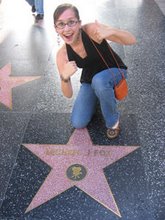
I have loved Michael J. Fox for as long as I can remember. Family Ties, Teen Wolf, the Back to the Future trilogy. I had a crush on him before I knew what a crush was. In high school, I watched Spin City, and wept when he left the show to be replaced by Charlie Sheen. I read his first autobiography Lucky Man as if I were reading a loved one's diary. Always Looking Up is very different than Lucky Man, but a welcome sequel. It focuses primarily on Fox's advocacy for stem cell research and his work to find a cure for Parkinson's. It's an interesting look at his life's work, a calling clearly more fulfilling to him than acting. It's clear that celebrity is a big part of his life, but that he has completed the transition to who he will be remembered as, far more than an adorable Canadian teen actor. (Note: audiobook read by the author himself)
Blankets by Craig Thompson
A coworker recommended this graphic novel to me, and I really wish someone had told me about it when I was a few years younger. I definitely enjoyed Thomspon's skillfully illustrated memoir, and it would have really struck a chord with me when I was a teenager. As an autobiography, Thompson's story has been heard before. Lonely child grows up poor, in an oppressively religious home, and finds hope when he finds love as a teenager. But his salvation comes through his artwork, his break with Christianity, and his escape from Tinytown. But the drawings are so graceful, his pain and subsequent deliverance drip off the page.
Shakespeare: The World as Stage by Bill Bryson
To date, the only other Bryson book I've read is his Australian travelogue In a Sunburned Country, and as I am currently reading his Shakespeare biography, I am very eager to continue reading his ouevre. I've previously read and enjoyed Stephen Greenblatt's Will in the World, and while Bryson's book covers much of the same information, it approaches it in a different way. Bryson opens the tome by explaining that while the world doesn't need another Shakespeare biography, his collection does. It's clear that Bryson is this curious genius, setting out to know what he can about our world and its history. And it's fun to have him explain what he's learned. Which in the world of Shakespeare, isn't much. The audiobook is read by Bryson himself, and it's like attending a teatime lecture by a friendly professor.
Next up, I've got Louisa May Alcott's classic Little Women on CD. I think for audiobooks, I'm going to be sticking to educational nonfiction and classics, as in all honesty, those would be the hardest for me to get through by reading the traditional method. Speaking of classics, I'm still reading Tolstoy's War and Peace which my boyfriend gave me for Christmas, and I am embarrassingly only about halfway through. I'm enjoying every bit of it, but it is simply not a page-turner.
Showing posts with label Bill Bryson. Show all posts
Showing posts with label Bill Bryson. Show all posts
Monday, August 10, 2009


Monday, December 24, 2007
kookaburras and wombats and cassowaries, oh my!
Well, because I'm the worst lit major ever, I think this may be the first time in the months since I started this blog that I'll be reviewing a book! In full disclosure, I've actually not quite finished it yet, but as I'm just a few pages to the end and leaving on a jet plane verrry soon, I'm going to go ahead and share my experience with Bill Bryson's In a Sunburned Country. This is one of the dozens of books I've been meaning to read for years now, and I'm glad I finally did.
I've been to Australia about a dozen times now, and I could never claim to "know it well." Many of the trips were made when I was young, and we often have gone just to Sydney. Bryson's books recounts his journeys around the Boomerang Coast (Adelaide, Canberra, Melbourne, Sydney, Surfers Paradise, Brisbane) which I'm familiar with (except for Adelaide), as well as his jaunts further north to Cairns, Darwin, and inland to Alice Springs. The book begins with his journey on the Indian Pacific railroad from Sydney to Perth, and later concludes with his journey north from Perth up to Darwin again. And that is basically all of - indeed, beyond - Australia that is Westernized. It's an enormous country with huge expanses of unlivable desert, and Bryson travels almost entirely around the perimeter (sometimes in fits and spurts, sometimes alone, sometimes with friends).
Except for his journey from Darwin to Alice Springs, and on to Uluru, Bryson does not venture into the great, arid unknown, and he could hardly be expected to! His travel diary is broken up with anecdotes gathered from the wealth of research Bryson has done about the continent, most focusing on the trials of the outback and the fascinating stories of those who have tried (occasionally successfully) to brave it. The book does a fantastic job of paying attention to the natural boon that is Australia (flora, fauna, climate, the Great Barrier Reef, etc.), in between pleasant stays in the country's few metropolises. Though he barely spends any time in Brisbane, and never really mentions Tasmania, the book is surprisingly complete, encompassing a country so vast, young, and unknown, in a way approachable to most readers.
By the midway point of the book, I must say Bryson's voice was grating on me. It has the sort of air of someone quite above average intelligence dumbing himself down for a grateful audience. He clearly possesses an encyclopaedic brain, but overuse of terms like "antipodean," "raffish," and "At [name of town], the only town worthy of the name..." kept my eyes rolling. Also, when my 9th grade english teacher told me not to use "you" in my writing, I thought it too stiff of a rule. I realize after reading Bryson, that it is in fact judicious to be conservative with it, at least. You know. Of course, I still kept wanting to turn the page to find out more of what Bryson could teach me, so really, who am I to complain?
I'd be interested to hear him talk more candidly about the actual Australian people, though. He studies the Aborigines with wonder, and honestly discusses the racial/social problems that do pertain, but only touches upon discussing them like people. It's clear he's not racist, and does sympathize with them, but I'm surprised he didn't just refer to them as "natives" sometimes. As to the rest of the Australians, he admires their "cuteness," which gets a little tired, though I can't say I disagree with the fact that a people characterized by a society halfway between England and the U.S.A. is quite charming.
All in all, I was impressed by Bryson's respect for the ancient wonder that the huge landmass is, and I'm looking forward to returning to the Boomerang Coast with the extra knowledge that I now have.
I've been to Australia about a dozen times now, and I could never claim to "know it well." Many of the trips were made when I was young, and we often have gone just to Sydney. Bryson's books recounts his journeys around the Boomerang Coast (Adelaide, Canberra, Melbourne, Sydney, Surfers Paradise, Brisbane) which I'm familiar with (except for Adelaide), as well as his jaunts further north to Cairns, Darwin, and inland to Alice Springs. The book begins with his journey on the Indian Pacific railroad from Sydney to Perth, and later concludes with his journey north from Perth up to Darwin again. And that is basically all of - indeed, beyond - Australia that is Westernized. It's an enormous country with huge expanses of unlivable desert, and Bryson travels almost entirely around the perimeter (sometimes in fits and spurts, sometimes alone, sometimes with friends).
Except for his journey from Darwin to Alice Springs, and on to Uluru, Bryson does not venture into the great, arid unknown, and he could hardly be expected to! His travel diary is broken up with anecdotes gathered from the wealth of research Bryson has done about the continent, most focusing on the trials of the outback and the fascinating stories of those who have tried (occasionally successfully) to brave it. The book does a fantastic job of paying attention to the natural boon that is Australia (flora, fauna, climate, the Great Barrier Reef, etc.), in between pleasant stays in the country's few metropolises. Though he barely spends any time in Brisbane, and never really mentions Tasmania, the book is surprisingly complete, encompassing a country so vast, young, and unknown, in a way approachable to most readers.
By the midway point of the book, I must say Bryson's voice was grating on me. It has the sort of air of someone quite above average intelligence dumbing himself down for a grateful audience. He clearly possesses an encyclopaedic brain, but overuse of terms like "antipodean," "raffish," and "At [name of town], the only town worthy of the name..." kept my eyes rolling. Also, when my 9th grade english teacher told me not to use "you" in my writing, I thought it too stiff of a rule. I realize after reading Bryson, that it is in fact judicious to be conservative with it, at least. You know. Of course, I still kept wanting to turn the page to find out more of what Bryson could teach me, so really, who am I to complain?
I'd be interested to hear him talk more candidly about the actual Australian people, though. He studies the Aborigines with wonder, and honestly discusses the racial/social problems that do pertain, but only touches upon discussing them like people. It's clear he's not racist, and does sympathize with them, but I'm surprised he didn't just refer to them as "natives" sometimes. As to the rest of the Australians, he admires their "cuteness," which gets a little tired, though I can't say I disagree with the fact that a people characterized by a society halfway between England and the U.S.A. is quite charming.
All in all, I was impressed by Bryson's respect for the ancient wonder that the huge landmass is, and I'm looking forward to returning to the Boomerang Coast with the extra knowledge that I now have.
Subscribe to:
Comments (Atom)

 Posts
Posts