Showing posts with label Almost Famous. Show all posts

Tuesday, April 24, 2007

the love song of p. seymour hoffman

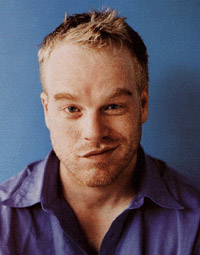
As Professor M taught me, a man doesn't have to be drop-dead gorgeous in order to win my love. From the first day sitting in his class, I felt my heart being swept away on the wings of his words forever. Something about his halted swagger, smooth velvety voice, and impeccable fashion sense just work together to create this frenetic sexual energy that radiates through the room as soon as he walks in... In Hollywood there are very few who have this same presence onscreen. One such man is the lovely Philip Seymour Hoffman.


Okay, so I've only seen twelve of his 47 IMDb acting credits, but I just wanted to say a few sweet words. The first time I was aware of PSH's virility and verve was in his role as Lester Bangs in Almost Famous. "The only true currency in this world is what we share with someone else when we're uncool." Teenage Kat in high school with her headphones on and her awkwardness and her dirty sneakers pretty much went nuts for that line. I later realized he wasn't a one-hit wonder when I saw him ironically-sans-pornstache in Boogie Nights. Paul Thomas Anderson brought us the ultimate trifecta of sexy-ugly with PSH, John C. Reilly, and Mark Wahlberg, and while the last two were running around shirtless and doing chicks, PSH's Scotty was making me sweat. Maybe it's the short shorts and the ill-fitting tank tops stretched over his expanse of stomach, maybe it's his awkwardly colored and poorly styled hair, but he brings so much anguish to his unrequited love for Dirk Diggler that whenever his character takes center stage, the dramatic irony reaches uncomfortable levels and I can't help but squirm in my seat watching everything go wrong.

What I loved about seeing many of Boogie Nights' actors return to working together in Magnolia was that they were still playing characters as insecure as their previous roles, but with completely different strengths and dynamics. As hospice nurse Phil Parma, he conveys a sensitivity and tranquility that Scotty would have been incredibly jealous of. At first I assumed the character was gay, but upon repeated viewings I realize this is not necessarily true. Though Parma lacks the raw sexiness of PSH, he is a completely believable young man who has simply settled into his place in life, but still manages to be surprised by what can make him feel. (Wow, just thinking of these PTA films is making me write an ode to John C. Reilly in my head. Maybe later...)

I wasn't sure what to expect out of Capote, movie-wise, but I am still impressed by PSH's range two years later. Apologetic yes-man Brandt in The Big Lebowski, greasy deviant priest Veasey (what a great name) in Cold Mountain, and now unlikable leading man. You know you've made it as a star when... Sure, at first the Truman voice was disconcerting, but the pacing and atmosphere of the picture allowed me to look past it after a while. As far as how the film made me feel about the true events and real people that inspired it, I won't attribute that to Mr. Hoffman. But the fact that he could bring gravitas to a character that most viewers are familiar with, all the while taking that squeaky voice completely seriously, just makes my heart swell.

Oh, what a man!


~Kat

P.S.

Monday, April 23, 2007

digital digital get down

Why am I a film studies major? Well, I suppose any college student questions why they chose their course of study, but with this one I can't quite explain it away by saying that I'm going to make a ton of money in I-Banking after I graduate. I came to a college with a gov/econ focus because I was intending to go into foreign service. One year and a dropped intro to economics class later, and I found myself declaring as a literature major.

Oh, the life of a lit major is as glamorous as you'd imagine, I promise. I think I read more when I was in elementary school. Oh well, I'd rather write essays than take exams any day. Also, it's a nice thing to have on my diploma as someone who takes great pleasure from the smell of old pages in stacks and stacks of library books.

So then as a sophomore I met Professor M. Oooh, Professor M. What a man... I was taking his journalism class in order to explore some career options, and I just became totally smitten. I signed up for his screenwriting class the next semester just so I could be close to him, but instead I found myself on a new career path with a second major.

I'm not the biggest fan of film majors, usually. Sometimes class discussions about Baudrillard and postmodernism feel like one big circle jerk of affected quasi-intellectualism, but then I find myself telling uninterested friends about the simulacrum or mise-en-scène, and I have to check myself (before I wreck myself). But I do so love cinema. And I like having the excuse as to why I watch so many movies and TV shows that it's research for my intended career as a screenwriter.

********************************************

In my Intro to Video Production class we've been talking a lot about the implications of the transition from film to digital. At first I didn't think the change was very meaningful past economics, but I've come to change my mind. As far as visual quality - sure, that's a given. But now with the cost-effective practice of filming digitally and editing to give "the film look," that's not even the most important part of the discussion. Ownership and distribution are obviously a big deal in the equation, too. With cheap cameras and YouTube, anyone can be a celebrity, and any material can be seen worldwide. I maintain that this is both a good thing and a bad thing, and refuse to come down strongly on either side.

But it was something I heard Quentin Tarantino say in a radio interview the other day that really struck me. "When you talk about the magic of cinema," he said (don't worry, I'm totally paraphrasing), you're referring to the illusion of movement. A film strip is just a row of static images which, when applied to the proper equipment and amount of light, trick us into believing that we are watching a moving image. With digital video, we are denied this magic. Not to say that beautiful, meaningful things can't be created digitally, but there is a lot to be said for celluloid moments like when Kate Hudson wipes away a tear from her right cheekbone with her left hand in Almost Famous, smiles, and asks, "What kind of beer?" Totally magical.

~Kat